Black Card
NASA is spending $4.1 billion per launch to send four adults past the Moon and back without actually landing on it, because ___________.
Cards Against Artemis™

Four humans. One Moon. No landing. $4.1 billion. The first crewed lunar mission since Apollo 17 lifted off on December 14, 1972. We had 54 years to think about this. This is what we came up with.
Artemis II is the first crewed mission under NASA's Artemis program — the second flight of the Space Launch System and Orion spacecraft, and the first time human beings will travel beyond low Earth orbit since Apollo 17 left the lunar surface on December 14, 1972. We have had 54 years to think about this. This is what we came up with.1
The mission uses a free-return trajectory — a figure-eight path that uses the Moon's gravity to redirect Orion back toward Earth without requiring a major engine burn. In the movies this is the scene where they say "shut down the engines and pray." In practice, NASA also prays.2
Orion will pass approximately 8,900 km above the lunar surface — close enough to see every crater, far enough that none of the four humans aboard may claim they walked on it. That honor is reserved for Artemis III. Whenever that happens.

The full mission profile spans approximately 10 days. From the 8.8 megaNewton liftoff through the ~25 minutes of radio blackout behind the Moon, through the 2,760°C re-entry, to the three pieces of fabric that constitute the entire landing system.
Key milestones: SRB separation at 50 km ($300M of littering), LAS jettison at T+3:30 (no more emergency exit), TLI burn at 1.5 hours (Earth is getting smaller), lunar flyby at day 4 (8,900 km closest approach, 25 min blackout), and splashdown in the Pacific at day 10.
Entry Interface at 121 km. Speed: 11.2 km/s. Heatshield max temp: 2,760°C. Peak deceleration: ~4g. Comms blackout from plasma sheath. Three parachutes between them and the Pacific. This is the plan.

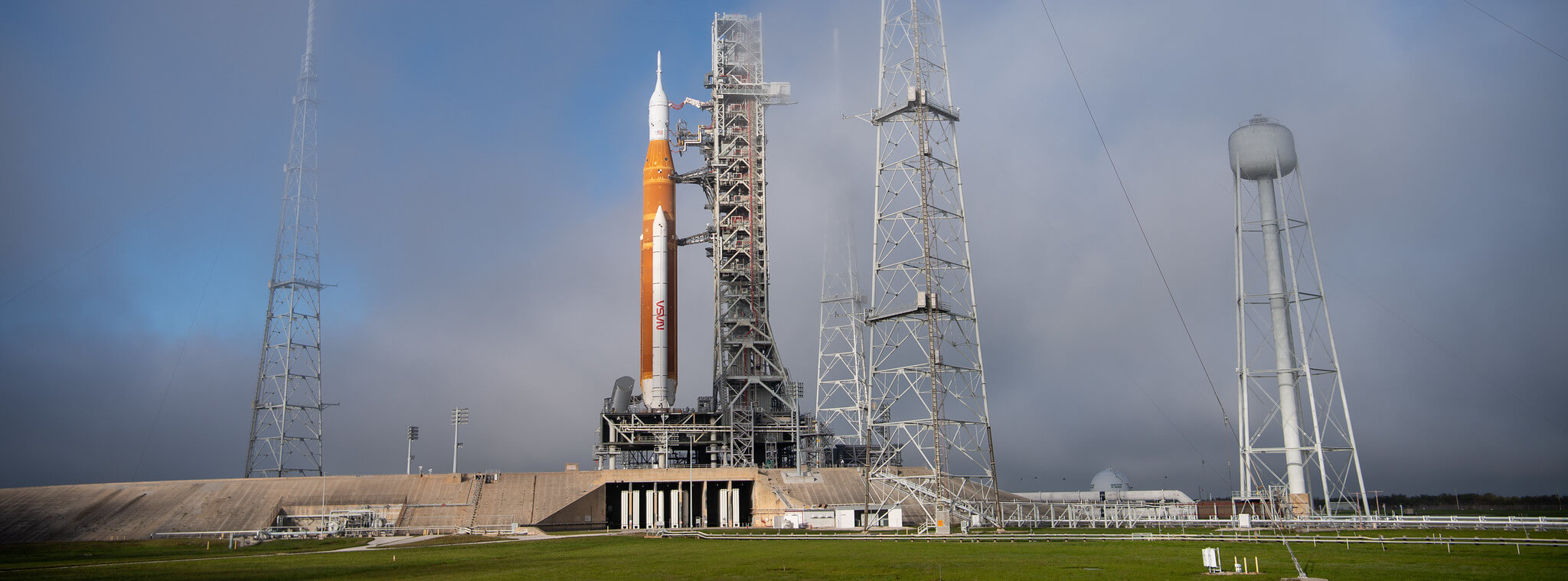
The Space Launch System Block 1 stands 98 meters tall — roughly a 30-story building — and weighs 2.6 million kilograms at liftoff. It produces 8.8 megaNewtons of thrust: more than any rocket ever successfully flown. It is also not reusable. Any of it. Not one bolt comes back.
The Orion Crew Module sits atop the SLS and is the only component that returns to Earth. Habitable volume: 8.95 cubic meters — less than a Honda Odyssey. Four adults will spend approximately 10 days in this space. NASA's Human Factors team has deemed this acceptable.
COST CONTEXT: At $4.1 billion per launch, Artemis II costs approximately 8× the GDP of Tuvalu, the full annual budget of NASA's science division, or 4.1 billion very good sandwiches.
All four have cleared NASA's psychological screening program, which apparently approved this specific plan.
Naval aviator and test pilot with 5,500+ flight hours. Spent 165 days aboard the ISS in 2014. Already knows what zero-g smells like. Still raised his hand.
Fighter pilot and test pilot veteran. Spent 168 days on the ISS. On Artemis II, he becomes the first Black astronaut to fly a lunar mission. Historically enormous.
Holds the record for the longest single spaceflight by a woman: 328 consecutive days. Conducted the first all-woman spacewalk. One of the first women to fly a lunar mission.
Former CF-18 fighter pilot. Has never been to space. His first mission is flying past the Moon. Canada's first deep-space astronaut. No pressure.
For approximately 25 minutes behind the Moon, Orion will lose all contact with Earth. No telemetry. No voice. No abort capability. Four humans, alone, behind the Moon. This is the plan.
Orion's toilet was redesigned after Artemis I because it wasn't "meeting crew expectations." There were no crew on Artemis I.
On Artemis I, the heatshield lost material unexpectedly. NASA published a 200-page report titled "it's fine."
Canada built the Canadarm3 for Gateway. That bought exactly one seat. On a flyby.
Each SLS launch costs approximately $4.1 billion. SpaceX's Falcon Heavy launches for roughly $150 million. But sure, let's keep going.
Originally 2024. Then late 2024. Then 2025. Now 2026. No one has placed money on the next date.
Tap a white card to fill the blank. Click a filled blank to clear it. Play it wrong.
NASA is spending $4.1 billion per launch to send four adults past the Moon and back without actually landing on it, because ___________.
“Congress keeps approving the budget anyway.”
“The PowerPoint looked really convincing in 2010.”
“We already printed the mission patches.”